

Engineer in Canada vs. Germany: (Salary & Lifestyle Guide)
The decision to take your engineering career abroad is monumental. In 2026, two of the most attractive global destinations are Canada and Germany. Both offer a high quality of life, robust job security, and a huge demand for skilled professionals in fields from Software to Mechanical Engineering.
However, their approach to salary, work culture, and immigration is vastly different.
This expert-level comparison cuts through the noise to detail the real differences in salary (adjusted for taxes), lifestyle, and the most current permanent residency (PR) pathways for engineers choosing between North America and Central Europe.
💰 Salary, Taxes, and Purchasing Power: A Real Money Comparison
When comparing compensation, engineers must look beyond the nominal gross salary. The real indicators are net salary (after tax) and local purchasing power (how much that money buys).
1. Nominal Salary: Who Pays More?
While salaries depend heavily on the city, industry, and experience, Germany generally holds a slight edge in nominal pay for some engineering disciplines, particularly in core manufacturing.
| Factor | Canada (CAD/USD) | Germany (€ EUR) |
| Average Software Engineer Salary | CAD $83,700$ (€62,000) | €63,000 |
| Average Mid-Level Engineer Salary | CAD $85,000$ (Industry Dependant) | €60,000 – €70,000 |
| Highest Paying City for Engineers | Toronto, Vancouver | Stuttgart, Hamburg, Dortmund |
| Tax/Contribution Impact | Moderate (Provincial variation) | High (High income tax + social contributions) |
For a Software Engineer, the average nominal salary is almost identical in both countries (approx. €62,000 to €63,000).

2. The Net Salary Reality Check
Due to Germany’s higher social security contributions and progressive income tax, an engineer’s net take-home pay is often significantly lower than in Canada, despite similar gross figures.
Expert Insight: An engineer in Toronto is actually 16% better off than an equivalent engineer in Berlin when taking into account both salary and the cost of living. This is because the overall cost of living, including housing, is often higher in Canada’s major cities, but the salaries adjust, and the tax burden is generally less severe.
🏗️ Industry Focus and Work Culture
The engineering career path you choose will be shaped by the country’s economic focus and its deeply ingrained work culture.
1. Industry Strengths
- 🇩🇪 Germany: The Industrial Giant. The market is strong and consolidated, focusing on Automotive, Manufacturing, Robotics, Mechanical, and Electrical Engineering. Companies like Siemens and BMW are global leaders. If your background is in traditional, heavy, or process-driven engineering, Germany is an excellent fit.
- 🇨🇦 Canada: The Tech & Resource Hub. The economy is driven by rapid growth in AI, Software Development, Fintech, and Renewable Energy. The market is often described as more flexible and growing.
2. Work-Life Balance and Efficiency
Germany is famed for its efficiency and strict work-life boundaries.
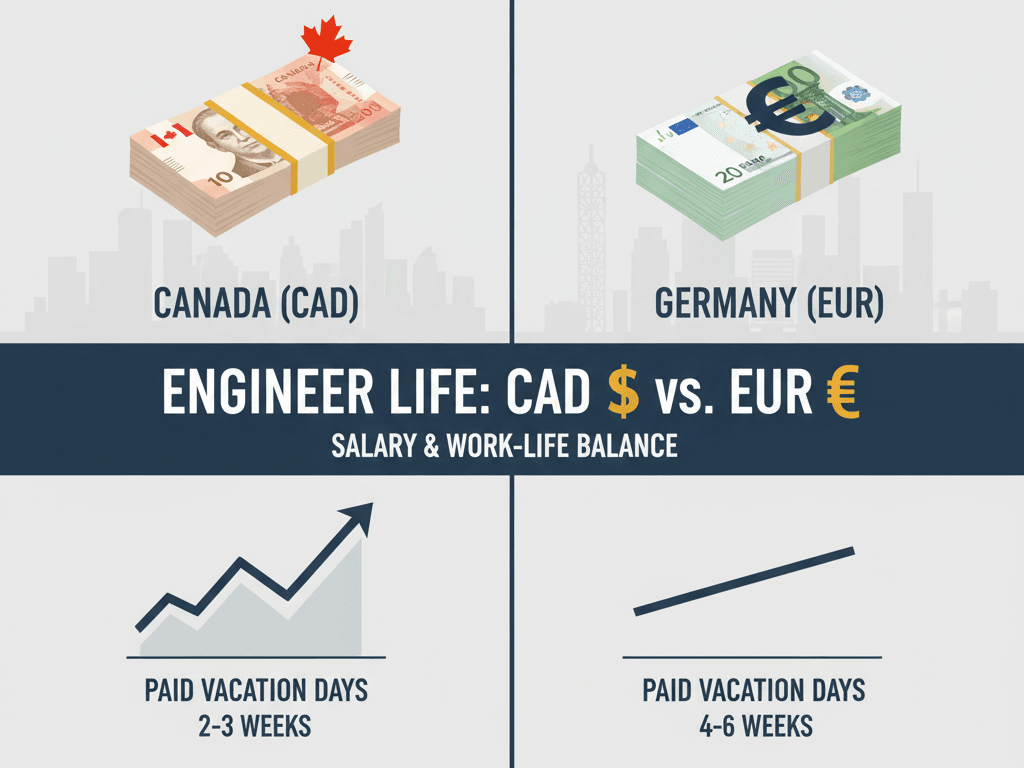
- Germany’s Ordnung (Order): Work is highly structured, punctual (Pünktlichkeit), and efficient, with minimal time wasted on small talk in meetings. Labor laws are highly pro-employee, limiting the average workday to 8 hours and guaranteeing a minimum of 20 days of paid leave (often 25–30 days in practice). Working long hours is not seen as a sign of dedication; efficiency within limits is. Germany’s Federal Ministry of Labour outlines employee rights and vacation entitlements in its Working in Germany Guide
- Canada’s Flexibility: Canada also prioritizes work-life balance. The culture is generally more flexible and adapts easily to diverse global styles. While highly valued, the WLB protection isn’t as strictly codified by law as it is in Germany.
🛂 Immigration: PR Pathways for Engineers
For long-term career planning, the ease of gaining permanent residency (PR) is critical. Canada offers a more established, transparent route, but Germany is rapidly improving its options.
1. The Canadian Pathway: Express Entry (CEC)
Canada is known as a global leader for its smooth, fair, and fast-track PR system.
- Express Entry: This is the main points-based system. Engineers, particularly in IT and in-demand fields, are strong candidates.
- Canadian Experience Class (CEC): The preferred route for engineers who complete a master’s or work for 1–2 years in Canada. The government is actively prioritizing applicants who are already settled, making it the highest chance for PR approval.
- Processing Time: PR approval can happen in as little as 6–8 months after receiving an Invitation to Apply (ITA).
2. The German Pathway: EU Blue Card
Germany is making significant efforts to attract skilled workers, notably through the EU Blue Card.
- EU Blue Card: A residence permit for academically qualified skilled workers (e.g., engineers) who have a job offer that meets a minimum salary threshold (€43,470 gross annual salary for shortage occupations in 2025).
- Path to PR: Blue Card holders can obtain a settlement permit (PR) after 33 months of employment and contributions. This period is drastically reduced to just 21 months if the applicant can demonstrate sufficient German language skills (B1 level).
| Pathway | Canada (PR Goal: Express Entry) | Germany (PR Goal: EU Blue Card) |
| Main System | Points-based (Age, Education, Experience, Language) | Job offer-based with salary threshold |
| Language Need for PR | English/French (IELTS/TEF is mandatory for points) | German optional to speed up PR from 33 to 21 months (B1 level) |
| Time to PR (Fastest) | 1–2 years (via CEC) | 21 months (with B1 German) |
✅ Conclusion
The “best” country for an engineer depends on your personal and professional values:
| Choose Canada 🇨🇦 If You Prioritize: | Choose Germany 🇩🇪 If You Prioritize: |
| Easiest, fastest PR pathway and a clear focus on retaining skilled workers. | A structured, legally protected work-life balance with excellent paid vacation time. |
| A high net income and greater purchasing power (e.g., Toronto vs. Berlin). | A career in heavy industry, automotive, or precision manufacturing. |
| A highly multicultural and adaptable environment where English is sufficient. | Central European travel and a strong, traditional economy. |
Your journey begins by perfecting your CV and LinkedIn profile. Don’t wait for your flight; start networking with recruiters in your target country today.
Frequently Asked Questions (FAQs)
Is Engineer in Canada a good career option in 2026?
Yes, becoming an Engineer in Canada is considered an excellent career choice in 2026 due to high demand across software, civil, mechanical, electrical, and AI sectors. Canada offers competitive salaries, strong job security, multicultural workplaces, and one of the world’s most accessible permanent residency pathways for skilled professionals.
What is the average salary for an Engineer in Canada compared to Germany?
The average salary for an Engineer in Canada is highly competitive and often results in stronger purchasing power because of lower overall tax pressure. While Germany also offers attractive engineering salaries, many professionals find that an Engineer in Canada may retain a higher net income after deductions.
Is permanent residency easier for an Engineer in Canada?
Yes, permanent residency is generally easier for an Engineer in Canada through systems like Express Entry and the Canadian Experience Class (CEC). Engineers with Canadian work experience, English proficiency, and strong educational backgrounds often receive priority under Canada’s skilled immigration programs.
Which industries hire the most Engineer in Canada professionals?
Technology, renewable energy, infrastructure, AI, construction, and manufacturing sectors are actively hiring Engineer in Canada professionals. Cities such as Toronto, Vancouver, Calgary, and Montreal continue to attract international engineers because of expanding innovation and infrastructure projects.
Does an Engineer in Canada need French language skills?
Most Engineer in Canada jobs only require English proficiency, especially in provinces like Ontario, Alberta, and British Columbia. However, French language skills can provide additional immigration points and career opportunities, particularly in Quebec and bilingual government-related engineering roles.
Is work-life balance better for an Engineer in Canada or Germany?
Germany is known for stricter labor protections and longer vacation policies, but an Engineer in Canada often benefits from a more flexible and adaptable workplace culture. Many Canadian employers emphasize employee wellbeing, hybrid work options, and multicultural team environments.
Is moving abroad worth it for an Engineer in Canada career path?
For many professionals, pursuing an Engineer in Canada career path is worthwhile because of strong salary growth, global work exposure, and long-term settlement opportunities. Canada is especially attractive for engineers seeking career advancement in tech-driven and innovation-focused industries.
What should I compare before becoming an Engineer in Canada?
Before becoming an Engineer in Canada, compare factors such as salary after taxes, cost of living, immigration pathways, licensing requirements, healthcare, and career growth opportunities. Evaluating these aspects carefully helps engineers choose the right province and long-term career strategy.