
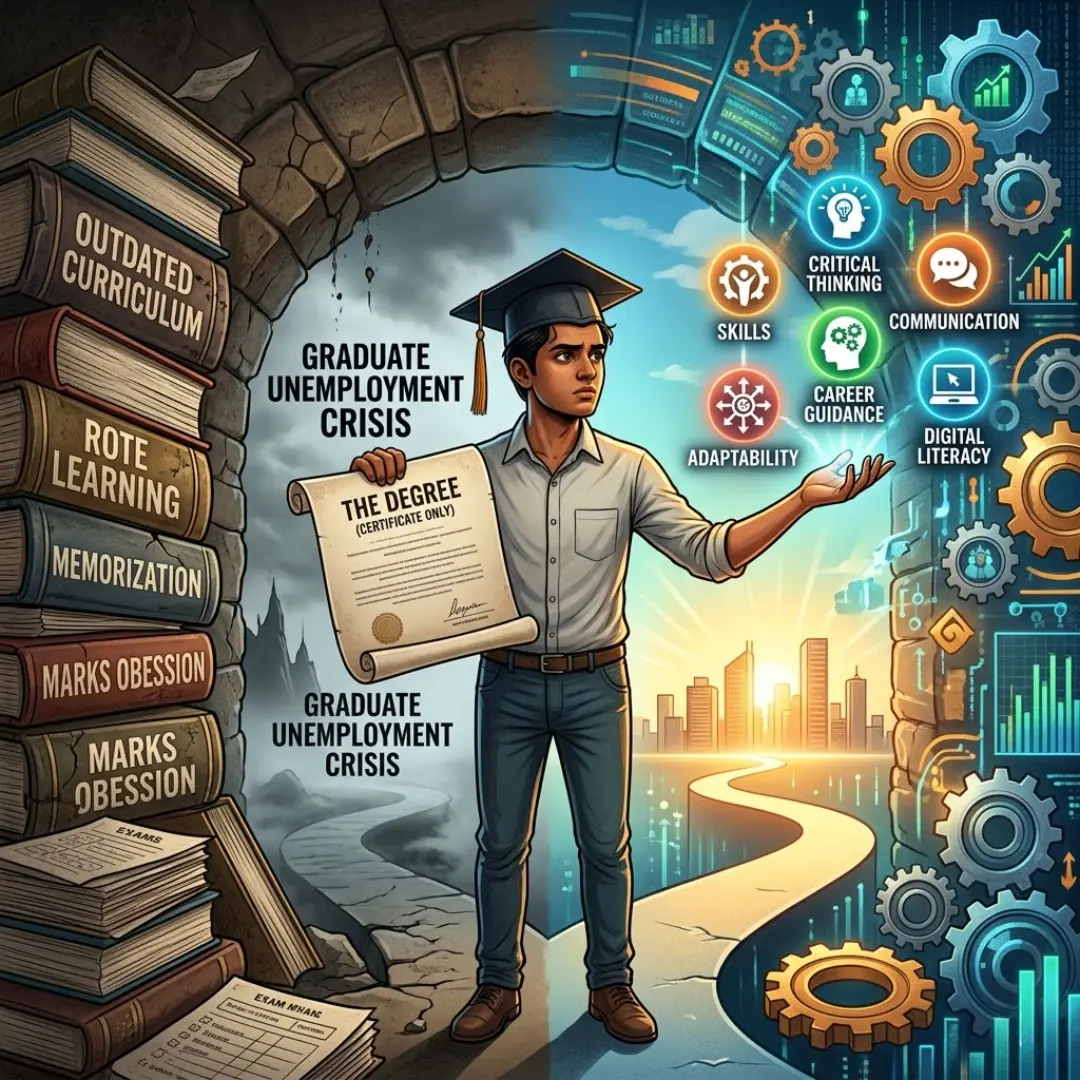
Why Higher Education in India Is Failing Its Students — And What Needs to Change
Every year, millions of Indian families make a tremendous sacrifice. Parents spend their savings. Students spend four, five, sometimes six years of their lives. And at the end of it all — a degree. A certificate. A handshake at a convocation ceremony.
But here is the question no one is asking loudly enough: Is that degree actually preparing students for real life?
The answer, backed by data, is increasingly: no.
Higher education in India has grown at a pace few countries can match. Today, India boasts over 900 universities and 40,000 colleges enrolling more than 36 million students — one of the largest higher education ecosystems on the planet. And yet, despite this massive expansion, a brutal reality persists beneath the surface. The problem with higher education in India is not access anymore. It is quality, relevance, and outcome.
The Graduate Employability Crisis: The Numbers Are Alarming
If you are searching for “why are Indian graduates unemployed” or “graduate employability in India,” here is what the data actually tells you.
According to the Mercer-Mettl India Graduate Skill Index 2025, only 42.6% of Indian graduates were considered employable in 2024 — a decline from 44.3% the previous year. This means that more than half of India’s graduating students are stepping into the job market without the skills employers are actually looking for.
The picture becomes even more troubling when you break it down:
- Employability in HR roles stood at just 39.9%
- Digital marketing graduates clocked in at 41%
- Only 44.3% of graduates showed adequate creativity — one of the most valued skills in the modern economy
And here is a statistic that should stop every policymaker in their tracks: the unemployment rate among graduates under 25 is approximately 42.3% — far higher than the 7.1% faced by those with only secondary education. A degree, in many cases, is not opening doors. It is creating a false sense of arrival.
This is not a personal failing of students. It is a systemic failure — one rooted in the outdated curriculum, theory-heavy learning, and near-complete absence of career-oriented education that defines higher education in India today.
The Skill Gap: What Students Learn vs. What Employers Need
Walk into most Indian college classrooms today and you will find students memorising textbook answers for examinations they will forget within months. Walk into a corporate office and you will find hiring managers complaining that fresh graduates cannot write a professional email, hold a confident conversation, or solve an unfamiliar problem.
This is the skill gap in higher education in India — and it is widening every year.
India’s job market in 2025 demands:
- Communication and presentation skills — yet only 55.1% of graduates are considered proficient
- Critical thinking — only 54.6% score well
- Leadership — 54.2% demonstrate capability
- Digital literacy, data analysis, and AI awareness — areas where most traditional syllabuses are years behind
Meanwhile, industries are being transformed by artificial intelligence, automation, data analytics, and global digital commerce. Students are learning about concepts that were relevant a decade ago while the world has moved on entirely.
The irony is painful. India has one of the youngest, most ambitious workforces in the world. But we are sending them into battle without the right weapons.
Why Rote Learning Is Killing Student Potential
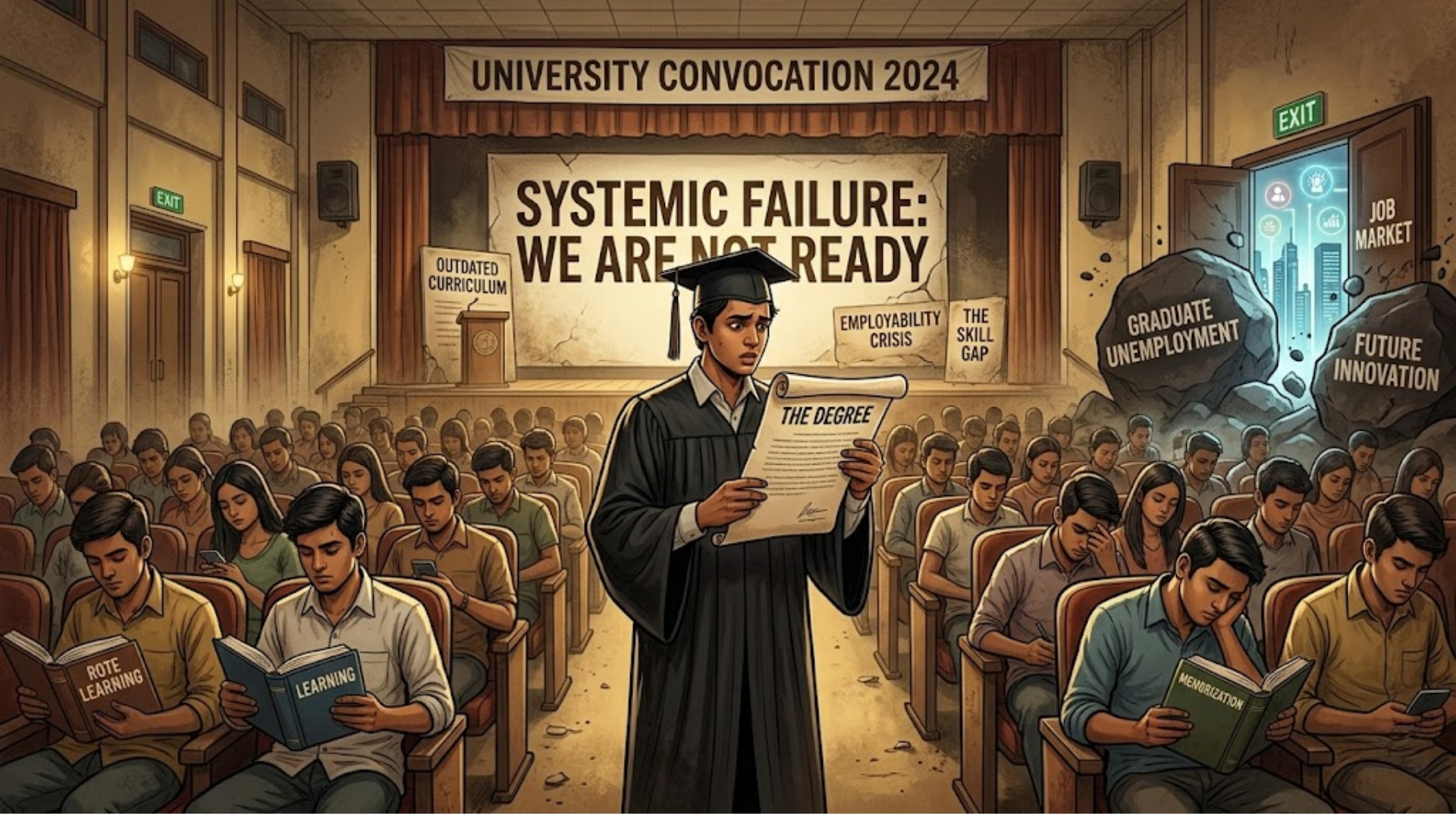
One of the deepest structural problems in higher education in India is the obsession with marks and memorisation.
From Class 1 to the final year of graduation, students are trained to reproduce — not to think. Examinations reward memory. Curiosity is rarely cultivated. Innovation is almost never encouraged.
The result? Students who can recite a definition of “entrepreneurship” but have never been asked to solve a real problem. Students who have studied “communication skills” as a subject but struggle to introduce themselves in a job interview.
Skill-based education — public speaking, financial literacy, design thinking, workplace etiquette, decision-making under pressure — remains an afterthought in most colleges. These are not soft skills anymore. They are survival skills in the modern economy. The future belongs to graduates who can think, adapt, communicate, and lead — not just those who can answer a multiple-choice question.
Career Guidance: The Invisible Crisis
Perhaps the most underreported problem in higher education in India is the complete absence of meaningful career counselling.
Most students in India choose their stream, their college, and their career path based on one of the following: parental pressure, what their neighbour’s son did, or what scored them the highest marks in Class 12. Very few students have ever had a genuine conversation with a qualified career counsellor. Very few have taken a proper aptitude test. Almost none have been helped to map their interests, strengths, and long-term goals before making a decision that will shape the next four decades of their life.
The consequences are predictable:
- Students trapped in courses they hate
- Graduates entering professions that drain them
- Young professionals switching careers within 2 years because they were never guided correctly in the first place
Career guidance for students in India is not a luxury. It is a necessity. When students understand themselves — their strengths, their natural abilities, and their career direction — they perform better, stay motivated longer, and contribute more meaningfully to the organisations that hire them.
The Infrastructure Problem: Not All Colleges Are Created Equal
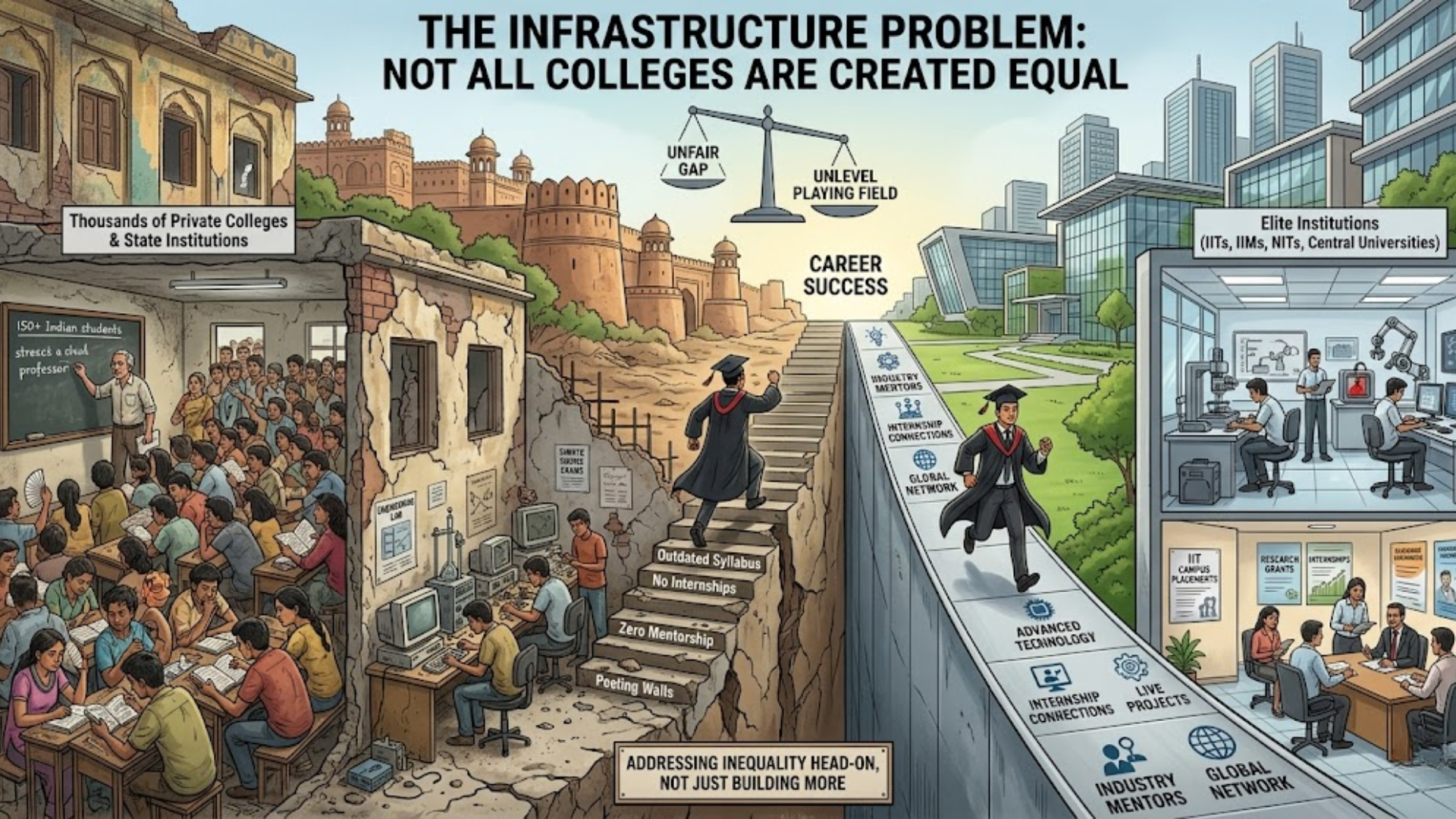
India’s higher education crisis is not uniform. There is a vast and deeply unfair gap between the elite institutions — the IITs, IIMs, NITs, and central universities — and the thousands of private colleges and state institutions where the majority of Indian students actually study.
Many colleges across India continue to struggle with:
- Overcrowded classrooms where one professor teaches 150 students
- Shortage of qualified faculty — particularly in engineering, technology, and management
- Outdated labs and infrastructure that are decades behind industry standards
- No access to research facilities, internship networks, or industry mentors
- Zero career counselling infrastructure for students who need it most
When a student from a small town college graduates, they are not just competing with their classmates. They are competing with graduates from better-resourced institutions who have had internships, guest lectures from industry experts, mock interviews, and live project experience. The playing field is anything but level.
Addressing the quality of higher education in India means addressing this inequality head-on — not just building more institutions, but seriously improving what happens inside them.
The Research and Innovation Deficit
India aspires to be a global knowledge economy. But the state of research and innovation in higher education in India tells a different story.
Most Indian colleges focus almost entirely on teaching for examinations — not on producing original knowledge. Research funding is scarce. University-industry collaboration is weak. Interdisciplinary thinking is rare. And the environment needed for genuine innovation — curiosity, experimentation, failure, iteration — simply does not exist in most campuses.
The consequences are visible globally. Despite producing hundreds of thousands of STEM graduates every year, India’s contribution to world-class research and patents remains disproportionately small. The students who do go on to research careers often leave for institutions abroad — a brain drain that costs the country enormously.
A world-class education system produces thinkers, researchers, and innovators — not just degree holders.
Why Indian Students Are Looking Abroad
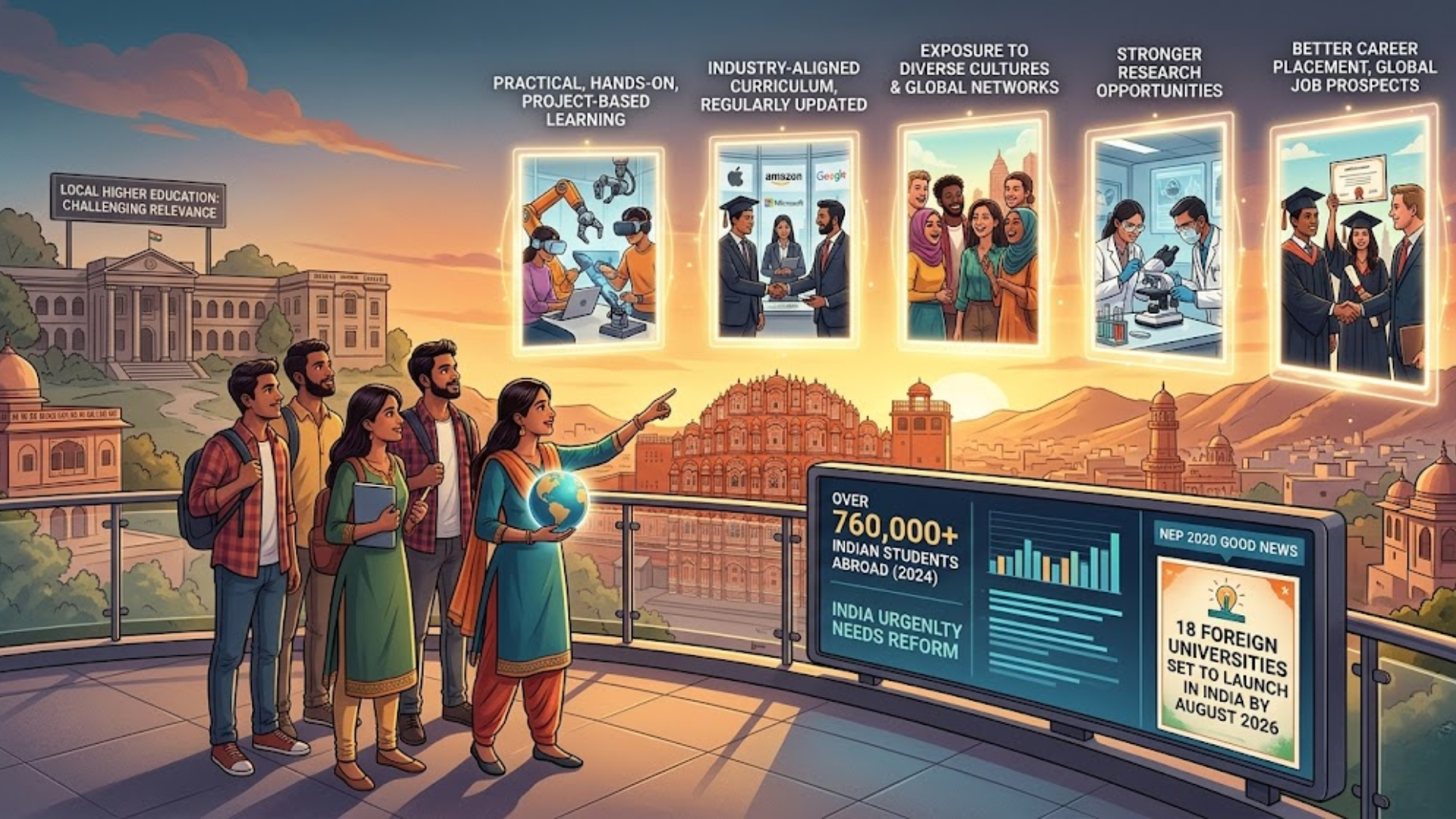
The numbers are telling. Indian students studying abroad peaked at 893,000 in 2023 and stood at approximately 760,000 in 2024, even as immigration policies in the USA and Canada tightened. Indian families collectively spent $3.7 billion on overseas education recently.
Why? Because students and their families believe — often correctly — that international universities offer:
- Practical, hands-on, project-based learning
- Industry-aligned curriculum that is updated regularly
- Exposure to diverse cultures and global networks
- Stronger research opportunities
- Better career placement and global job prospects
This is not a criticism of Indian students. It is a signal that higher education in India urgently needs to deliver what students are willing to travel thousands of kilometres and spend lakhs of rupees to find elsewhere.
The good news: under NEP 2020, at least 18 foreign universities are set to launch programmes in India by August 2026. This is a significant step — but policy change alone cannot fix a systemic problem overnight.
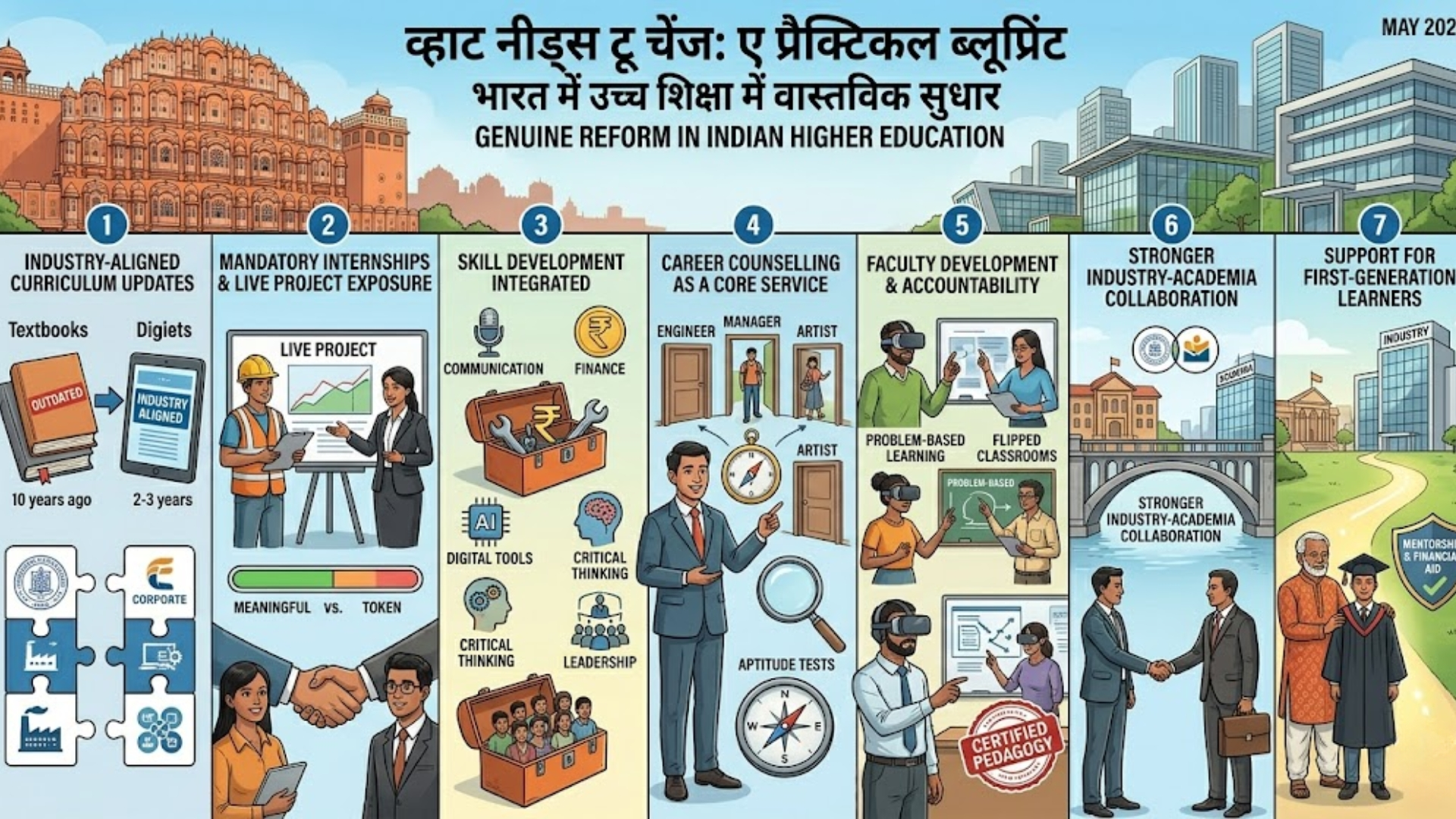
What Needs to Change: A Practical Blueprint
The problems facing higher education in India are real, serious, and well-documented. But they are not unsolvable. Here is what genuine reform looks like:
1. Industry-Aligned Curriculum Updates Syllabuses must be reviewed and updated in collaboration with industry partners every 2–3 years — not every decade. Students should graduate knowing what the current job market actually requires.
2. Mandatory Internships and Live Project Exposure Degrees should require meaningful internship experience. Not token summer internships, but structured, assessed placements that give students real-world problem-solving exposure.
3. Skill Development Integrated Into Every Programme Communication, financial literacy, digital tools, critical thinking, and leadership development should not be optional add-ons. They should be woven into every programme across every college.
4. Career Counselling as a Core Service Every higher education institution should have trained career counsellors, aptitude assessment tools, and structured programmes to help students understand themselves before they make life-altering career choices.
5. Faculty Development and Accountability Teachers must be trained not just in their subject matter but in modern pedagogy — problem-based learning, case studies, flipped classrooms, and experiential learning. Qualification alone is not enough.
6. Stronger Industry-Academia Collaboration Companies must be brought into the classroom — through mentorship, co-designed courses, hackathons, research partnerships, and placement programmes. Education cannot happen in isolation from the economy it serves.
7. Support for First-Generation Learners Millions of Indian students are the first in their families to attend college. They need additional mentoring, financial support, and career awareness programmes to navigate a world their parents never entered.
The Bigger Picture: What Education Is Really For
There is a question worth sitting with: What is a degree actually supposed to do?
It is not just about getting a job — though that matters enormously for financial independence and family security. Education, at its best, is supposed to expand what a person can see, think, and do. It is supposed to build confidence, sharpen judgment, and create people who can navigate an uncertain world with resilience and skill.
India does not lack talent. Walk into any small town in Rajasthan, Bihar, or Odisha and you will find young people of extraordinary intelligence, drive, and creativity — many of whom will graduate from colleges that will equip them with almost nothing practical.
The real cost of a broken education system is not just unemployment. It is wasted potential at a national scale. It is a generation of capable people who were handed a certificate instead of a foundation.
As Rabindranath Tagore wrote: “The highest education is that which does not merely give us information, but makes our life in harmony with all existence.”
Higher education in India must stop measuring itself by enrollment numbers and graduate counts. The only measure that matters is this: Are students leaving college more capable, more confident, and more prepared to contribute than when they arrived?
Until the answer to that question is a clear and consistent yes — for students from every background, every region, and every college — the work of reform is not finished.
The future of India’s workforce is being shaped right now, in classrooms across the country. What happens in those classrooms — whether students are taught to think or just to remember, whether they are guided or just graded — will determine the kind of nation India becomes over the next 25 years. That is not a small thing. That is everything.
Frequently Asked Questions
What is the biggest problem with higher education in India today?
The biggest problem with higher education in India is the widening gap between what colleges teach and what employers actually need. Most institutions still rely on theory-heavy, rote-learning curricula that leave graduates without practical skills, communication ability, or real-world problem-solving experience.
Why is there such a large skill gap in higher education in India?
The skill gap in higher education in India exists primarily because most college syllabuses are outdated and disconnected from industry requirements. Students spend years memorising textbooks but rarely develop public speaking, leadership, financial literacy, or digital skills. Meanwhile, industries are rapidly evolving with AI, automation, and data analytics — areas most traditional curricula are years behind on.
Is a college degree from India enough to get a good job
A degree alone is no longer sufficient in today’s job market. Higher education in India produces millions of graduates every year, but employers consistently report that fresh graduates lack workplace-ready skills. Degrees need to be backed by internship experience, communication skills, digital knowledge, and critical thinking — qualities that most Indian colleges still do not actively develop.
Why do so many Indian students choose to study abroad instead of staying in India?
Students choose to study abroad because international universities offer practical, project-based learning, industry-aligned curricula, and stronger career placement support — things that higher education in India has historically struggled to provide. In 2023 alone, nearly 893,000 Indian students were enrolled in overseas universities, with families collectively spending $3.7 billion on foreign education.
What role does career guidance play in fixing higher education in India?
Career guidance is one of the most critical — and most ignored — solutions to the crisis in higher education in India. Most students choose their stream based on parental pressure or peer influence rather than personal aptitude. Without proper counselling, students end up in wrong courses, graduate unmotivated, and switch careers within two years. Structured career counselling should be a core service in every Indian college.
How is NEP 2020 trying to improve higher education in India?
The National Education Policy 2020 introduces several reforms aimed at modernising higher education in India, including multidisciplinary learning, flexible degree structures, skill-based coursework, and provisions for foreign universities to establish campuses in India. At least 18 global universities are set to launch programmes in India by 2026. However, effective implementation across thousands of colleges remains the real challenge.
What practical changes can actually improve higher education in India?
Improving higher education in India requires a multi-layered approach: updating syllabuses in collaboration with industry every 2–3 years, making internships mandatory, integrating skill development into every degree programme, and providing structured career counselling at all institutions. Stronger industry-academia collaboration, investment in faculty training, and support for first-generation learners are equally essential to building a future-ready education system.