
Introduction
The morphology of flowering plants is a core topic in NEET and forms the foundation for plant classification, adaptation, and understanding advanced plant biology. This guide covers every important aspect as per the NEET-UG syllabus, blending concepts, diagrams, exam tips, and multiple-choice questions for confidence and clarity in exams.
Importance of Morphology of Flowering Plants in NEET
The morphology of flowering plants is heavily tested in NEET, directly and indirectly, through MCQs on roots, stems, leaves, flower parts, fruit, seed differences, and plant families. A strong grasp of this topic ensures speed and accuracy, helping students secure high marks.
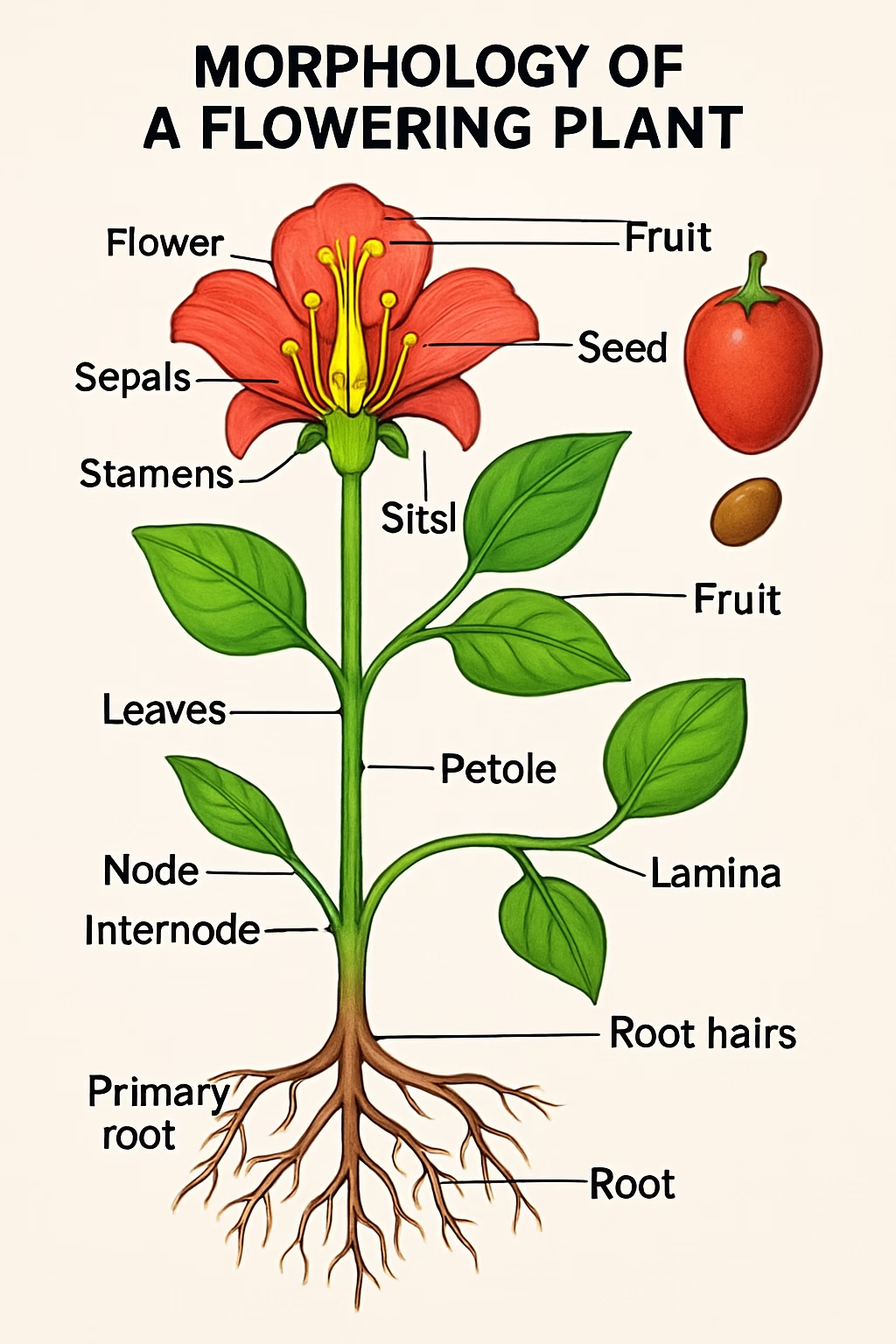
Overview: Main Parts of a Flowering Plant
Root System and Its Modifications
Types:
Tap root (main root with lateral branches; e.g. mustard, gram)
Fibrous root (many equal roots from stem base, e.g. wheat, grass)
Adventitious roots (roots arising from stem/leaves, e.g. banyan, maize)
Modifications:
Storage (carrot, sweet potato)
Support (prop roots in banyan, stilt roots in sugarcane)
Respiration (pneumatophores in mangroves)
Functions: Anchorage, absorption, storage, transport
Stem and Its Modifications
Structure: Bears leaves, flowers, fruits; nodes and internodes visible.
Modification:
Underground (rhizome: ginger; tuber: potato; bulb: onion)
Subaerial (runner, stolon; e.g. grass, strawberry)
Aerial (tendril in cucumber, thorn in bougainvillea)
Functions: Support, transport, storage, vegetative propagation
Leaf Structure and Types
Basic Parts: Leaf base, petiole, lamina
Modifications: Tendrils (pea), spines (cactus), storage leaves (onion)
Phyllotaxy: Alternate (mustard), opposite (guava), whorled (Alstonia)
Functions: Photosynthesis, transpiration, storage
Inflorescence: Types and Examples
Definition: Arrangement of flowers on the floral axis.
Types:
Racemose (main axis grows indefinitely, e.g. mustard, grape)
Cymose (main axis ends in a flower, e.g. jasmine, hibiscus)
Special Types: Cyathium (Euphorbia), Hypanthodium (fig)
The Flower: Whorls, Parts, and Key Concepts
Whorls: Calyx (sepals), Corolla (petals), Androecium (stamens), Gynoecium (carpels)
Symmetry: Actinomorphic (radial, e.g. chilli), Zygomorphic (one plane, e.g. pea)
Bracts: Bracteate (with bract), Ebracteate (without)
Ovary Position: Hypogynous (superior, e.g. mustard), Perigynous (half-inferior, e.g. rose), Epigynous (inferior, e.g. guava)
Androecium: Monadelphous (cotton), diadelphous (pea), polyadelphous (citrus)
Placentation: Marginal (pea), axile (tomato), parietal (mustard)
Aestivation: Valvate, twisted, imbricate, vexillary
Fruit and Seed Structure
Fruit: Mature ovary after fertilization; types—simple, aggregate, multiple
Seed: Embryo with cotyledons; categorized as monocot or dicot depending on number of seed leaves
Differences Between Monocot and Dicot Seeds: Number of cotyledons, structure, endosperm presence
Key Differences Between Monocots and Dicots
| Feature | Monocot (e.g. grass, rice) | Dicot (e.g. pea, bean) |
|---|---|---|
| Cotyledons | One | Two |
| Leaf Venation | Parallel | Reticulate |
| Flower Parts | Multiples of 3 | Multiples of 4 or 5 |
| Root System | Fibrous | Tap root |
| Vascular Bundles | Scattered | In a ring |
| Secondary Growth | Absent | Present |
Important Plant Families for NEET
Fabaceae (Leguminosae): Pea, bean
Zygomorphic, vexillary aestivation, diadelphous stamens
Solanaceae: Tomato, potato
Actinomorphic, twisted corolla, axile placentation
Liliaceae: Onion, tulip
Trimerous flowers, superior ovary, parallel venation
Semi-Technical Description of a Typical Flowering Plant
Learn the format for describing a plant in semi-technical terms as per NEET pattern—habit, root type, stem nature, leaf arrangement, inflorescence, flower type, floral formula, and diagram.
Example:
“Herbaceous, taproot system, simple alternate leaves, racemose inflorescence, bisexual actinomorphic flowers; floral formula: ⊕ ⚥ K5 C5 A(9)+1 G1”
Solved NEET MCQs
Q1: The roots that originate from the base of the stem are (a) fibrous roots.
Q2: Sweet potato is a modified (b) adventitious root.
Q3: Roots play insignificant role in absorption of water in (d) Pistia.
Q4: Pneumatophores occur in (a) vegetation in marshy and saline lakes.
Q5: Clinging roots are present in (d) orchids.
Q6: Velamen tissue is found in aerial roots of orchids.
Include plenty of practice MCQs from the morphology of flowering plants for exam readiness.
FAQs on Morphology of Flowering Plants
Why is Morphology of Flowering Plants important for NEET preparation?
Morphology of Flowering Plants is one of the most important Botany chapters in NEET because it contributes direct questions every year. It forms the foundation for understanding plant classification, plant families, floral formulas, and structural adaptations, making it essential for scoring well in the Biology section.
Which topics in Morphology of Flowering Plants are most frequently asked in NEET?
The most commonly tested topics in Morphology of Flowering Plants include root modifications, stem modifications, leaf arrangements, inflorescence types, floral symmetry, placentation, aestivation, fruit and seed structure, and characteristics of important plant families such as Fabaceae, Solanaceae, and Liliaceae.
How can students easily remember Morphology of Flowering Plants for NEET?
Students can master Morphology of Flowering Plants by using diagrams, flowcharts, comparison tables, and regular MCQ practice. Focusing on examples, plant family characteristics, floral formulas, and root, stem, and leaf modifications helps improve retention and quick recall during examinations.
How many questions can be expected from Morphology of Flowering Plants in NEET?
While the exact number varies each year, Morphology of Flowering Plants typically contributes one to three direct questions and supports several indirect questions from plant anatomy, plant physiology, and taxonomy. Strong preparation can therefore improve overall Botany performance significantly.
What is the difference between monocots and dicots in Morphology of Flowering Plants?
In Morphology of Flowering Plants, monocots generally have one cotyledon, parallel venation, fibrous roots, and floral parts in multiples of three. Dicots usually possess two cotyledons, reticulate venation, tap roots, and floral parts in multiples of four or five.
Why are plant families important in Morphology of Flowering Plants?
Plant families are crucial because NEET frequently asks questions about floral characteristics, examples, placentation, and floral formulas. Understanding Fabaceae, Solanaceae, and Liliaceae within Morphology of Flowering Plants helps students answer both conceptual and application-based questions accurately.
What are the most important root, stem, and leaf modifications in Morphology of Flowering Plants?
Students should focus on storage roots such as carrot and sweet potato, support roots like prop roots and stilt roots, stem modifications such as rhizomes and tubers, and leaf modifications including tendrils, spines, and storage leaves. These examples are commonly tested in NEET examinations.
Quick Revision Table
| Topic | Key Point | Example |
|---|---|---|
| Tap Root | Main root, dicot plants | Mustard, gram |
| Fibrous Root | Equal roots from stem base, monocots | Wheat, grass |
| Adventitious Root | Develop from parts other than radicle | Sweet potato, maize |
| Racemose Inflorescence | Main axis grows indefinitely | Mustard, grape |
| Cymose Inflorescence | Main axis ends in flower | Jasmine |
| Monocot Seed | One cotyledon, parallel veins | Rice |
| Dicot Seed | Two cotyledons, netted veins | Pea, bean |
Summary
Mastering the morphology of flowering plants ensures clarity in plant biology, fast recall in NEET, and is the gateway to higher-order concepts in botany. Revise with diagrams, notes, MCQs, and focus on plant families for top results in your exam.
Want to stay ahead in your journey abroad? Follow
Study Abroad tips, scholarships & updates
@tensorinternational
MBBS Abroad admissions, NEET-low score options & country guides 👉 @mbbsabroad2027
Jobs Abroad alerts, visa info & career hacks
@tensorinternational_official
Follow now for expert insights, real-time updates & exclusive opportunities!