

Study in India for Nigerian Students: Admission, Scholarships, Fees and Visa Guide
Are you a Nigerian student planning to study abroad but looking for a destination that offers diverse academic opportunities, internationally oriented education and a range of study options? India is a destination worth exploring.
From engineering, computer science and business management to healthcare, agriculture and postgraduate research, Indian institutions offer programmes across many academic disciplines. Nigerian students can also explore scholarship opportunities, including the India-Africa Maitri Scholarship administered by the Indian Council for Cultural Relations (ICCR).
However, before choosing India, you probably have some important questions:
- Can I study in India with WAEC or NECO results?
- Do Nigerian students need JAMB or IELTS?
- Are there scholarships available for Nigerians?
- How much does it cost to study in India?
- How can I obtain an Indian student visa?
- Will my Indian qualification be recognised in Nigeria?
This guide answers these questions and explains how Tensor International can help Nigerian students understand their study options and move towards admission in India.
Nigerian students can also benefit from exploring our African Students – Amazing Study in India Opportunities guide, which highlights scholarships, academic programmes, admission pathways, and key advantages of studying in India for students from across the African continent.
Why Are Nigerian Students Considering India for Higher Education?
India has an established educational relationship with Nigeria. Indian institutions have welcomed Nigerian students for decades, creating an existing connection between the two countries in education and academic exchange.
There are several reasons Nigerian students may consider India.
1. Diverse academic programmes
Indian universities offer undergraduate, postgraduate and doctoral programmes in fields such as engineering, computer science, business, healthcare, agriculture, science and humanities.
2. English-medium education
English is widely used in Indian higher education, although the teaching language should always be confirmed for the specific university and programme.
3. Different university and budget options
Students can explore institutions in different Indian cities, with varying tuition fees, accommodation arrangements and living expenses. This allows families to compare options according to their academic goals and financial circumstances.
4. Scholarship opportunities
Government scholarship schemes and university-specific fee waivers can help eligible international students manage education expenses.
5. Exposure to a different academic and cultural environment
Studying in India provides an opportunity to experience a diverse society, interact with students from different countries and develop an international perspective.
The right university, however, depends on your chosen course, academic background, budget and future career plans.
What Courses Can Nigerian Students Study in India?
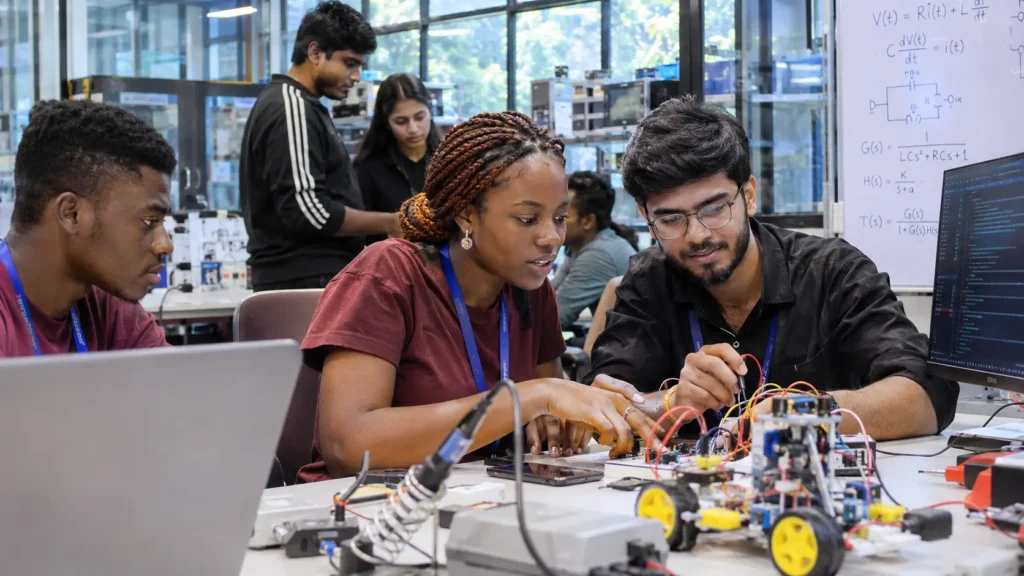
Nigerian students can explore a wide range of academic programmes in India. Your eligibility will depend on your previous qualifications and the admission requirements of the institution.
| Course category | Popular study options |
|---|---|
| Engineering | Mechanical, Civil, Electrical, Electronics |
| Computer Science and IT | Computer Science, Software Development, Artificial Intelligence, Data Science |
| Business and Management | BBA, MBA, Finance, Marketing |
| Healthcare | Nursing, Pharmacy, Biotechnology, Public Health |
| Medicine | MBBS and other medical programmes, subject to applicable eligibility and recognition requirements |
| Agriculture | Agricultural Science, Food Technology, Agribusiness |
| Science | Physics, Chemistry, Mathematics, Biotechnology |
| Arts and Humanities | Economics, Psychology, International Relations, Media Studies |
| Hospitality | Hotel Management, Tourism, Hospitality Management |
Whether you want to pursue a bachelor’s degree after secondary school or a master’s degree after graduation, the first step is to identify programmes that match your academic qualifications.
Not sure which course is suitable for your background? Speak with a Tensor International education consultant to discuss your interests, previous education and possible course options in India.
Can Nigerian Students Get Admission in India With WAEC or NECO Results?
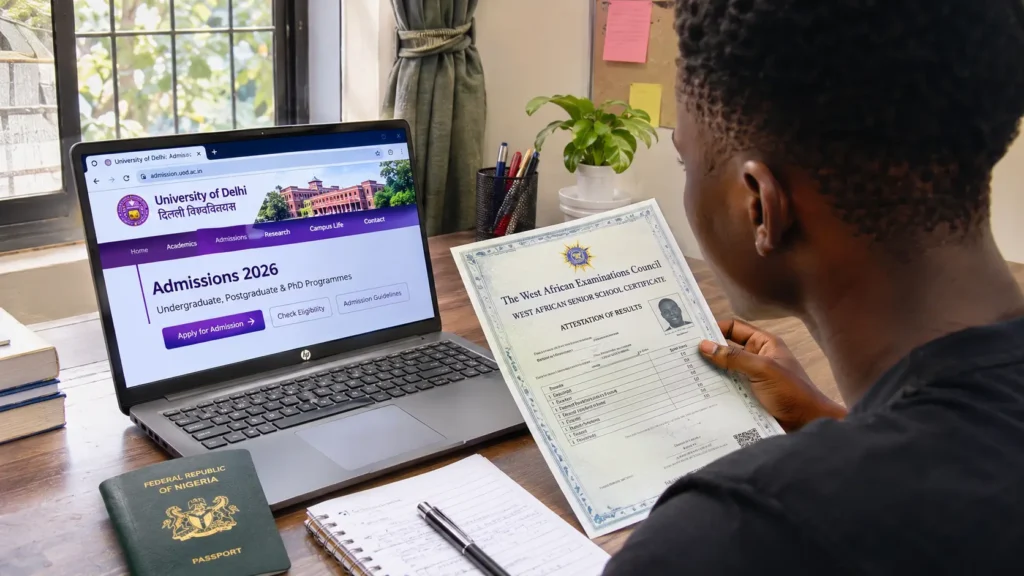
Yes, Nigerian students can explore undergraduate admission using their secondary-school qualifications. However, acceptance of WAEC or NECO certificates and the required grades depend on the university, programme and subject requirements.
Do Indian universities accept WAEC results?
WAEC (West African Examinations Council) conducts the West African Senior School Certificate Examination (WASSCE), which is an important secondary-school qualification for Nigerian students.
Indian universities may consider WASSCE results for international undergraduate applications. However, students must confirm:
- Required grades and subject combinations.
- Whether English Language and Mathematics credits are necessary.
- Whether the university accepts one or multiple examination sittings.
- Whether additional academic documents are required.
Can I apply with NECO results?
NECO (National Examinations Council) Senior School Certificate results may also be considered by institutions assessing Nigerian applicants.
The acceptance criteria are not identical across all Indian universities. Your results, subjects and intended course must be evaluated against the institution’s entry requirements.
Is JAMB required to study in India?
JAMB/UTME is primarily associated with admission into Nigerian universities. Indian universities establish their own international admission criteria, so JAMB should not be assumed to be a universal requirement for admission in India.
Do Nigerian students need IELTS?
Not necessarily. English-language requirements vary between institutions and programmes. Some universities may accept previous English-medium education or other evidence of English proficiency, while others may request a test or additional documentation.
Tensor International can help you understand which academic documents and eligibility conditions need to be checked before you proceed with an application.
Scholarships in India for Nigerian Students
One of the biggest concerns for families planning overseas education is funding. Fortunately, Nigerian students have opportunities to explore government scholarships and university-level financial assistance.
1. India-Africa Maitri Scholarship

The India-Africa Maitri Scholarship is administered through the Indian Council for Cultural Relations (ICCR).
For the 2026–27 academic year, the official ICCR scheme lists 40 scholarship slots for Nigeria under the India-Africa Maitri Scholarship.
The scheme covers eligible undergraduate, postgraduate and PhD programmes in STEM and non-STEM disciplines.
Depending on the applicable scholarship rules, benefits can include:
- Prescribed tuition or academic fees.
- Monthly stipend.
- House Rent Allowance (HRA).
- Contingency allowance.
- Thesis or dissertation allowance, where applicable.
- Return economy-class airfare.
Important: Medical, law and integrated courses are excluded under this particular scheme. Hostel or private accommodation charges, mess expenses, security deposits and certain other costs may remain the student’s responsibility.
The number of slots does not guarantee selection. Applicants must meet the current eligibility conditions, follow the official application procedure and satisfy the scholarship authority’s requirements.
Official information: ICCR Scholarship Schemes.
2. University scholarships and tuition fee waivers
Some Indian institutions offer merit-based scholarships or tuition fee concessions to international students.
These may depend on:
- Previous academic performance.
- Programme and level of study.
- Institutional scholarship policies.
- Availability of funding.
- Individual admission conditions.
A fee waiver is not necessarily a fully funded scholarship. Students should understand exactly which expenses are covered before accepting an offer.
Want to know which scholarship opportunities may suit your academic profile? Contact Tensor International to discuss your qualifications, intended course and possible funding routes.
How Much Does It Cost to Study in India From Nigeria?
The total cost depends on the institution, course, city and accommodation arrangement. There is no single fee that applies to every Nigerian student.
Before making a decision, consider the following expenses:
| Expense | What to consider |
|---|---|
| Tuition fees | Annual programme fees and payment deadlines |
| Accommodation | University hostel or private housing |
| Food | Meals, groceries and personal preferences |
| Transportation | Local travel and commuting |
| Academic expenses | Books, equipment and study materials |
| Healthcare | Insurance and medical expenses |
| Visa and administration | Application and immigration-related charges |
| International travel | Flights and travel preparation |
| Personal expenses | Communication, clothing and emergency funds |
Planning your budget in Nigerian naira
Indian university fees are generally quoted in Indian rupees (INR). Nigerian families should calculate the total expected expense in INR and then estimate its equivalent in Nigerian naira (NGN).
Currency exchange rates and international transfer charges can change the final amount.
Before committing to a university, make sure you understand the complete fee structure, accommodation costs, refund conditions and payment schedule.
Tensor International can help you discuss the financial considerations and compare suitable study options according to your budget.
How Can Nigerian Students Apply to Indian Universities?
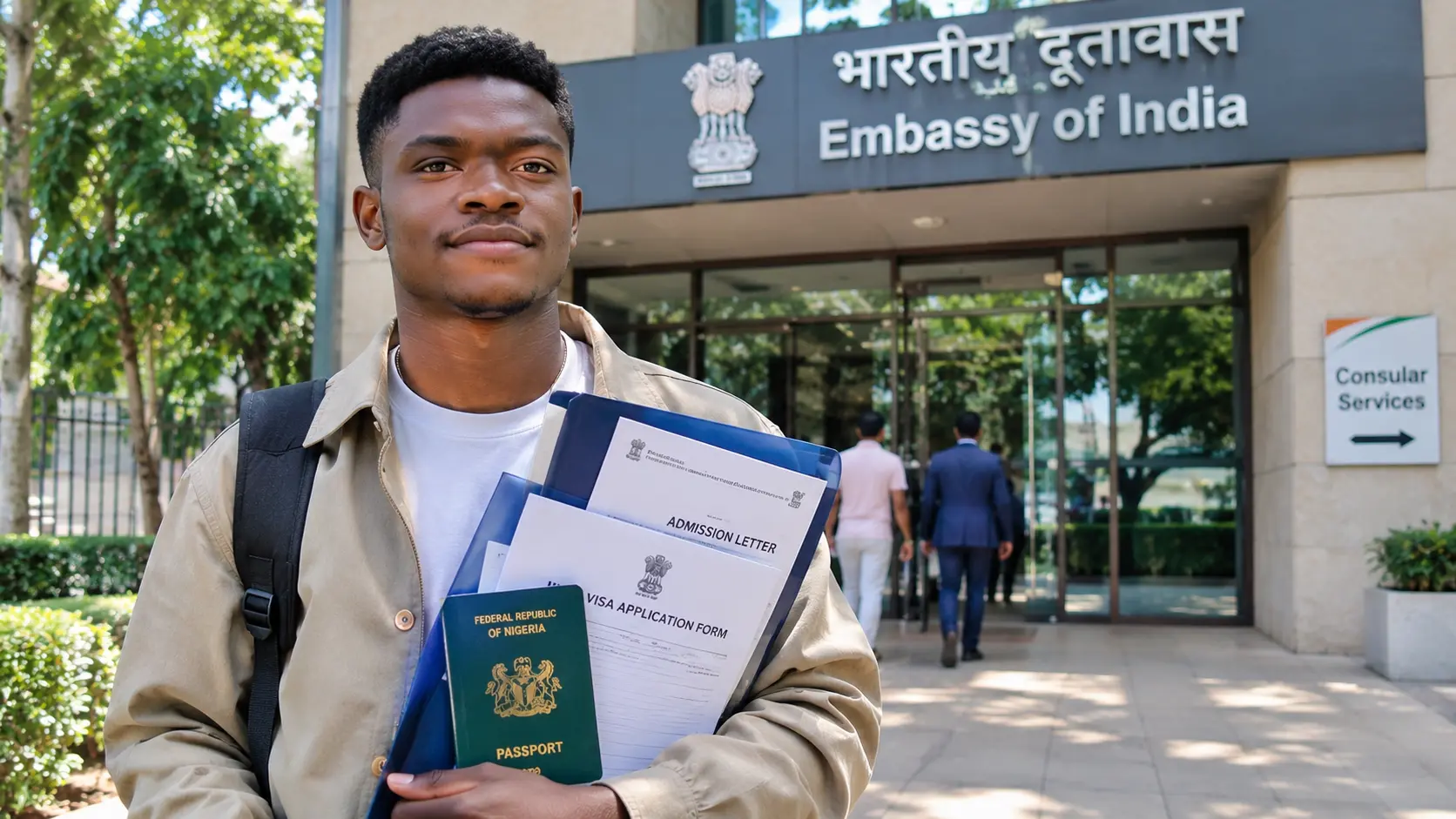
The admission process becomes easier to understand when divided into clear stages.
Step 1: Identify your course and academic level
Decide whether you want to pursue an undergraduate, postgraduate or doctoral programme.
Step 2: Check your academic eligibility
Your WAEC, NECO, bachelor’s degree or other previous qualifications must meet the entry requirements of the intended institution.
Step 3: Shortlist suitable universities
Compare institutions based on course availability, recognition, tuition fees, programme duration and accommodation.
Step 4: Prepare your documents
Commonly requested documents may include:
1. International passport.
2. WAEC or NECO certificate and results, where applicable.
3. Academic transcripts.
4. Previous degree certificates, for postgraduate applicants.
5. Passport-size photographs.
6. Other documents required by the university.
Step 5: Submit your application
Follow the relevant university’s international admission procedure. The Government of India’s Study in India programme also uses an SII ID to support the application journey of international students.
Step 6: Review your admission offer
Check the course, fees, admission conditions and payment deadlines before accepting an offer.
Step 7: Prepare for the student visa
Once you have the required admission documentation, proceed with the appropriate visa application.
Rather than navigating these decisions without guidance, Nigerian students can contact Tensor International to discuss course selection, university options, academic eligibility and the admission process.
Indian Student Visa Requirements for Nigerian Students
Obtaining the correct visa is an essential part of planning your education in India.
Commonly required documents may include:
- Valid Nigerian international passport.
- Completed visa application.
- Recent photographs.
- University admission or offer letter.
- Academic and course details.
- Evidence of financial support.
- Address and other supporting documents requested by the Indian mission.
Can Nigerians apply for an Indian e-Visa?
This is an important country-specific detail.
According to the current visa instructions published by the High Commission of India in Abuja, there is no e-Visa facility for Nigerian nationals. Visa applications must be submitted in person at the High Commission of India in Abuja or the Consulate General of India in Lagos, with the required physical documents.
The mission also makes clear that accepting an application does not guarantee visa approval.
Visa requirements, fees and procedures can change, so applicants should confirm the latest instructions before submitting documents.
Official reference: High Commission of India, Abuja – Visa Instructions.
Do not make non-refundable travel arrangements before your visa has been approved.
What Is Student Life Like for Nigerians in India?

Moving to another country involves more than attending university. Students also need to adjust to a new environment.
Here are some practical considerations.
Accommodation: Students may live in university hostels or private accommodation. Availability, costs and facilities vary by institution.
Food: Indian cities offer a variety of food options and international grocery choices. Students may need time to identify familiar ingredients and suitable meals.
Language: English is widely used in higher education, but local languages differ between states and cities. Learning basic local expressions can make everyday life easier.
Climate: India has different climatic conditions across its regions. Students should consider the climate of their intended university location.
Safety and support: Check campus security, international student services, healthcare facilities and accommodation arrangements. Students should know whom to contact if they experience difficulties or discrimination.
Preparing for these practical matters before departure can make the transition smoother.
Will an Indian Degree Be Recognised in Nigeria?
This is an important question for Nigerian students who intend to return home after graduation.
Before enrolling, consider:
- Whether the Indian institution has the appropriate recognition.
- Whether the specific programme meets relevant academic and professional requirements.
- Whether your intended profession requires registration with a Nigerian regulatory body.
- Whether the qualification will need evaluation or verification in Nigeria.
The National Universities Commission (NUC) provides foreign qualification evaluation and verification services. Professional fields such as medicine, nursing and pharmacy may have additional registration and licensing requirements.
Can Nigerian graduates from India participate in NYSC?
Foreign-trained Nigerian graduates must follow the applicable NYSC registration and verification requirements.
The NYSC foreign-trained graduate checklist specifically mentions degree certificates, official transcripts and mark sheets for Indian universities. Additional professional documents may be required for certain occupations.
You should understand these requirements before selecting your course, particularly if NYSC participation is part of your future plans.
Official reference: NYSC – Requirements for Foreign-Trained Graduates.
Frequently Asked Questions
Can Nigerian students study in India after secondary school?
Yes. Nigerian students can explore undergraduate programmes after secondary education, subject to the university’s academic eligibility and admission requirements.
Can I study in India with WAEC or NECO?
Indian institutions may consider WAEC and NECO qualifications. Required grades, subject combinations and certificate acceptance must be confirmed with the intended university.
Are there fully funded scholarships in India for Nigerian students?
Eligible Nigerian students can apply for certain ICCR scholarship schemes. The actual benefits and selection conditions depend on the scheme. Not every scholarship covers all living and accommodation expenses.
How many ICCR scholarships are available for Nigerians?
The 2026–27 India-Africa Maitri Scholarship allocation lists 40 slots for Nigeria. This allocation is subject to the scheme’s eligibility and selection process.
Do Nigerian students need IELTS?
Not in every case. English proficiency requirements depend on the university and programme.
Can Nigerians get an Indian student e-Visa?
The current High Commission of India visa instructions state that Nigerian nationals do not have access to the e-Visa facility and must submit applications in person through Abuja or Lagos.
Can Nigerian students work in India after graduation?
Completing a degree does not automatically provide permission to work in India. Graduates must meet the applicable immigration and employment requirements.
Is India a good option for Nigerian students?
India may be suitable for students seeking diverse academic programmes, English-medium education and scholarship opportunities. The right choice depends on course quality, university recognition, budget and career objectives.
Planning to Study in India From Nigeria? Talk to Tensor International
Choosing a university in another country is a major decision for both students and families. You need more than a list of institutions. You need to understand which courses match your qualifications, what admission requirements apply, what the financial commitment looks like and how to prepare for the next steps.
Tensor International is expanding its international education services to help students from Nigeria and other countries explore higher education opportunities in India.
Our goal is to help prospective students understand their options and make informed decisions about their education journey.
Whether you have completed WAEC or NECO, hold a bachelor’s degree, are exploring scholarships or simply want to understand the admission process, start by discussing your requirements with our team.
Speak with a Tensor International education consultant to discuss:
- Suitable courses based on your academic background.
- Indian university and programme options.
- Admission eligibility and required documents.
- Scholarship opportunities and funding considerations.
- Tuition fees and overall study budget.
- Student visa preparation and next steps.
You do not have to figure out the entire process alone.
Start your journey towards studying in India with Tensor International.
Visit Tensor International and get in touch with our team to discuss your study plans.