
Morphology of Flowering Plants: NEET Notes, Solved Questions, and FAQs
Understanding the morphology of flowering plants is essential for NEET and class 11 biology. In this detailed blog, you’ll find notes, frequently asked NEET questions with detailed explanations, clear diagrams and tables, as well as a comprehensive FAQ section. Ace your preparation with concepts made easy for both revision and SEO ranking!
Introduction
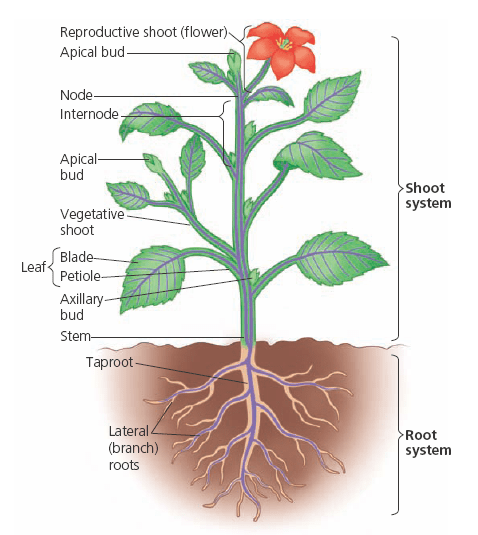
Flowering plants, or angiosperms, are the most diverse and widespread plant group on earth. Analyzing their morphology—structure and form—helps in understanding classification, adaptation, and various core functions, forming a major part of the NEET Biology syllabus.
The Root System of Flowering Plants
Types of Root Systems
| Root Type | Features / Origin | Examples |
|---|---|---|
| Tap Root System | Develops from radicle, forms main root, gives off laterals | Mustard, Gram (Dicots) |
| Fibrous Root System | Primary root is short-lived, replaced by many equal roots from stem base | Wheat, Rice (Monocots) |
| Adventitious Roots | Develop from parts of plant other than radicle, often stem or leaf | Grass, Banyan, Maize, Sweet potato |
Key Modifications and Functions
Storage: Swollen for reserve food (e.g. carrot – tap root, sweet potato – adventitious root)
Support: Prop roots (Banyan), stilt roots (Maize, Sugarcane)
Aeration: Pneumatophores in mangroves (Rhizophora, Avicennia)
Absorption: Root hairs increase surface for water/nutrients
Specialized Roots: Clinging roots (Orchids), Velamen roots (Aerial roots in orchids absorb moisture)
Key Differences: Monocot vs Dicot Flowers
| Feature | Monocotyledons (Monocots) | Dicotyledons (Dicots) |
|---|---|---|
| Petal Arrangement | Multiples of 3 | Multiples of 4 or 5 |
| Leaf Venation | Parallel veins | Reticulate/net-like veins |
| Number of Cotyledons | One | Two |
| Root System | Fibrous | Tap root |
| Vascular Bundle | Scattered in stem | In a ring |
| Ovule Number | Usually many per ovary | One or few per ovary |
NEET MCQs with Detailed Answers & Explanations
Q1. The roots that originate from the base of the stem are: (NEET 2020)
Options:
(a) Fibrous roots
(b) Primary roots
(c) Prop roots
(d) Lateral roots
Answer: (a) Fibrous roots
Explanation: In monocot plants like wheat and rice, the primary root dies early and is replaced by a mass of similar-looking roots that arise from the base of the stem, forming a fibrous root system. Such roots are thin, thread-like, and equal in size. This adaptation is typical in monocots and helps with quick absorption of water/nutrients and anchorage.
Q2. Sweet potato is a modified: (NEET 2018)
Options:
(a) Stem
(b) Adventitious root
(c) Tap root
(d) Rhizome
Answer: (b) Adventitious root
Explanation: Sweet potato (Ipomoea batatas) is not a stem or rhizome structure; instead, it is a swollen, storage root known as a root tuber. These arise from extra-radicle parts (adventitious roots) and store food, making them rich in starch.
Q3. Roots play insignificant role in absorption of water in: (2015)
Options:
(a) Pea
(b) Wheat
(c) Sunflower
(d) Pistia
Answer: (d) Pistia
Explanation: Pistia, or water lettuce, is a floating aquatic plant. In aquatic habitats, roots are poorly developed and water/nutrients are mainly absorbed by the body surface (leaves and stem). Roots are present for balance or anchorage, not for absorption.
Q4. Pneumatophores are found in: (2000)
Options:
(a) Vegetation found in marshy & saline lakes
(b) Vegetation in acidic soil
(c) Xerophytes
(d) Epiphytes
Answer: (a) Vegetation found in marshy & saline lakes
Explanation: Pneumatophores are specialized roots that grow vertically upwards, aiding in gaseous exchange under waterlogged, anaerobic conditions. They are “breathing roots” of mangroves like Rhizophora, Avicennia, which occur in saline, marshy areas.
Q5. The plant which bears clinging roots is: (1999)
Options:
(a) Screw pine
(b) Podostemon
(c) Trapa
(d) Orchid
Answer: (d) Orchid
Explanation: Orchids are epiphytes bearing different types of roots. Clinging roots arise from the nodes and help the plant attach itself to surfaces, providing support in an aerial/no-soil environment, typical of orchids.
Q6. Velamen is found in: (1991)
Options:
(a) Roots of screwpine
(b) Aerial & terrestrial roots of orchids
(c) Leaves of Ficus elastica
(d) Aerial roots of orchids
Answer: (d) Aerial roots of orchids
Explanation: Velamen is a thick, spongy, multiple epidermis covering the aerial roots of epiphytic orchids. It absorbs atmospheric moisture and protects delicate tissues from dessication.
Frequently Asked Questions (FAQs)
Is Morphology of Flowering Plants important for NEET?
Yes. Morphology of Flowering Plants is one of the most important Botany chapters in NEET. Questions are frequently asked from root modifications, stem modifications, leaf arrangements, inflorescence, floral characters, plant families, placentation, and floral formulae.
How many questions are usually asked from Morphology of Flowering Plants in NEET?
On average, 2–4 questions are directly asked from Morphology of Flowering Plants every year. In addition, concepts from this chapter are often linked with Plant Kingdom, Anatomy of Flowering Plants, and Biological Classification.
Which topics are most important in Morphology of Flowering Plants for NEET?
Students should focus on root modifications, stem modifications, leaf modifications, inflorescence types, placentation, aestivation, floral symmetry, ovary position, and characteristics of Fabaceae, Solanaceae, and Liliaceae families.
Which plant families are most important for NEET from Morphology of Flowering Plants?
Fabaceae, Solanaceae, and Liliaceae are the most important families. Students should memorize floral formulae, placentation, aestivation, inflorescence, economic importance, and representative examples from each family.
What is the difference between tap root, fibrous root, and adventitious root?
Tap roots develop from the radicle and are common in dicots. Fibrous roots arise from the base of the stem and are common in monocots. Adventitious roots originate from plant parts other than the radicle and often perform storage or support functions.
Why are root modifications frequently asked in NEET?
Root modifications combine concepts with examples, making them ideal for application-based MCQs. Questions commonly involve storage roots, prop roots, stilt roots, pneumatophores, clinging roots, and velamen roots.
What are the most frequently repeated NEET questions from Morphology of Flowering Plants?
Questions on sweet potato, potato, onion, ginger, pneumatophores, prop roots, stilt roots, placentation, floral formulae, and family characteristics of Fabaceae, Solanaceae, and Liliaceae are repeatedly seen in NEET examinations.
Q: Why are roots in aquatic plants like Pistia not efficient in absorbing water?
In floating aquatic plants, water is absorbed through the whole body; roots may be reduced or just help in anchorage.
Q: What’s the biological significance of pneumatophores?
They supply oxygen to submerged roots in mangrove swamps by sticking above the water surface and absorbing air.
Q: How do orchids survive as epiphytes?
With specialized aerial roots having velamen tissue, they absorb moisture and nutrients from the air, and clinging roots attach to the host.
Q: Can roots act as storage organs? Give examples.
Yes, some roots store food (carrot – tap root; sweet potato – adventitious root).
Q: What are prop and stilt roots?
Prop roots: Descend from branches to provide support (Banyan tree).
Stilt roots: Arise from lower nodes to anchor and support (Maize, Sugarcane).
Q: What is meant by adventitious roots?
Roots growing from any part except the radicle, often for support, storage, or vegetative propagation.
Q: What is the function of velamen tissue?
Protects and absorbs moisture in aerial roots of epiphytes (esp. orchids).
Q: Are all modified roots found underground?
No, some (like prop, stilt, pneumatophores, clinging, and velamen roots) function above ground or in aerial spaces.
Quick Revision Table
| Modification | Plant Example | Function | Special Feature |
|---|---|---|---|
| Storage Tap Root | Carrot | Food storage | Main root swells |
| Storage Adventitious Root | Sweet potato | Food storage | Stem-like root |
| Prop Root | Banyan | Mechanical support | From branches downwards |
| Stilt Root | Maize, Sugarcane | Support to tall plants | From lower stem nodes |
| Pneumatophore | Mangrove (Rhizophora) | Respiration | Vertical, air-absorbing |
| Clinging Root | Orchid | Attachment to host | Node-origin, sticky |
| Velamen Tissue | Orchid (Epiphyte) | Water absorption | Spongy, aerial root cover |
Final Tips for NEET Aspirants
Always pair concepts with examples—most NEET MCQs are application-based.
Draw neat diagrams and learn labels for root modifications and flower parts.
Use tables for quick revisions before the exam.
Practice MCQs from previous years for best results.
Keep referring to NCERT and reputable coaching notes for updates. Stay curious and consistent. All the best for your NEET journey!
Want to stay ahead in your journey abroad? Follow
Study Abroad tips, scholarships & updates
👉@tensorinternational
🩺 MBBS Abroad admissions, NEET-low score options & country guides 👉 @mbbsabroad2027
Jobs Abroad alerts, visa info & career hacks
👉 @tensorinternational_official
Follow now for expert insights, real-time updates & exclusive opportunities!
At Tensor International, we don’t just help you in MBBS Abroad—we help you build careers across borders.
✈️ Interested in MBBS Abroad?
🌐 Visit us at: https://tensorinternational.com/
📞 Call: 7877951237
📧 Email: ceotensor@gmail.com